

Puerta de Alcalá in Madrid: history, origin and curiosities
The Puerta de Alcalá in Madrid: origin, history and curiosities
The Puerta de Alcalá in Madrid is one of the city’s most iconic
and recognizable monuments. However, its history goes back much further
than it may seem at first glance and is closely linked to the urban evolution
of Madrid since the Middle Ages.

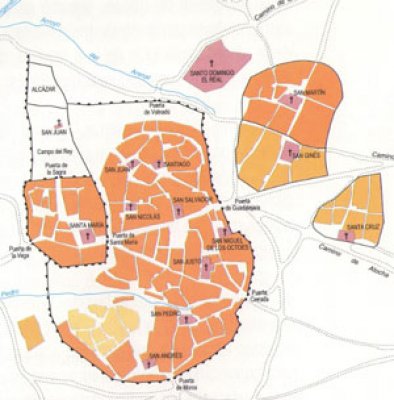
🏰 Madrid in the 10th century: a walled city
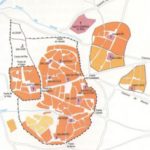
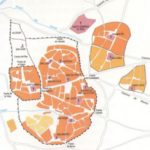
In the 10th century, Madrid was a fully walled city,
protected by two clearly differentiated defensive enclosures:
- 🟤 The Caliphal wall, which enclosed the Alcázar.
- 🟤 The Christian wall, which surrounded the suburban area.

As in most medieval cities, the walls included city gates
located where the main access roads began.
In 10th-century Madrid there were five main gates:
one to the north, one to the south, one to the west,
and two facing east.
Today, no visible remains of these gates survive,
but their layout can still be traced through Madrid’s urban structure
and historical areas such as
El Retiro Park,
whose configuration is also closely linked to the city’s historical development.
🛤️ The Puerta de Guadalajara, predecessor of the Puerta de Alcalá
When researching the historical origins of the Puerta de Alcalá,
we find traces of an earlier gate known as the Puerta de Guadalajara.
This gate opened the road towards Alcalá de Henares,
continuing on to Guadalajara
and ultimately reaching the lands of the former Kingdom of Aragon.
It played a strategic role from both a commercial and defensive perspective.
🚶♂️ For history enthusiasts, walking through Madrid with this background in mind
is particularly fascinating.
Many streets and routes conceal stories and legends,
such as those described in
The Nun of the Stigmata, a Madrid street legend,
which help explain the origins of the city’s urban layout.
🏛️ The current Puerta de Alcalá: Charles III and Sabatini
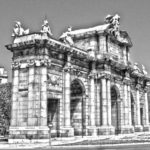
The Puerta de Alcalá as we know it today
was designed by the architect Francesco Sabatini,
commissioned by King Charles III.
Although the origins of the city gate date back to the 10th century,
the previous structure—built under Philip III—
disappointed Charles III upon his arrival in Madrid in 1759.
As a result, the king ordered the construction of a new monumental gate
worthy of the capital of the kingdom.
Today, a city gate may seem purely symbolic,
but historically it represented:
- 🔐 A control point for travelers and goods.
- 💰 A symbol of wealth and power.
- 🏛️ A representative image of the city.
For this reason, the new Puerta de Alcalá was designed
to reflect the grandeur of Charles III’s reign.
🎭 A famous curiosity: two different façades
One of the most striking features of the Puerta de Alcalá
is that it has two different designs,
one on each side of the monument.
According to tradition, Charles III rejected several earlier designs
by architect Ventura Rodríguez.
He then entrusted the project to Sabatini,
who presented two distinct proposals.
As both pleased the king, it was decided to build one on each façade.
🔍 Curious visitors can easily spot the differences:
- Different numbers of columns
- Distinct pediments
- Varying sculptural compositions
📊 Historical overview of the Puerta de Alcalá
| Period | Key fact |
|---|---|
| 10th century | Madrid becomes a walled city with five main gates |
| Middle Ages | Existence of the Puerta de Guadalajara |
| 1759 | Charles III orders the construction of a new gate |
| 18th century | Construction of the Puerta de Alcalá by Sabatini |
Today, the Puerta de Alcalá is a must-see landmark
for any 21st-century visitor,
not only for its artistic value,
but also for the rich urban history it represents.
© Written by the editorial team of architecture.vilssa.com