

How to Light Dark Interior Spaces with Natural Daylight
Practical guide to lighting dark interior spaces in buildings
Definition. Lighting dark interior spaces refers to a set of passive and technical solutions designed to capture natural light from illuminated areas of a building and conduct or reflect it into rooms where sunlight does not enter directly.
Lighting dark spaces. Design solutions such as light colors and reflective surfaces can improve the perception of brightness, but they do not guarantee effective illumination. To properly light interior areas without direct sunlight, technical systems for capturing, conducting, or reflecting natural light are required.
Technical criteria for lighting interior spaces without direct sunlight
- 📍 Light source
Light must be captured from roofs, façades, or courtyards where sufficient direct or indirect solar radiation is available. - 🏠 Type of space
Living spaces, galleries, and inner courtyards do not require the same solution. The intended use determines the appropriate system. - 🧩 Installation complexity
In existing buildings, feasibility depends on the routing of ducts and their interaction with beams and partitions.
Natural light conduction systems
Light conduction systems transport natural light from illuminated areas to interior rooms without windows.
- ☀️ Reflective solar tubes
These systems capture light through glass domes on the roof and conduct it via highly reflective aluminum tubes. They are fully passive and require minimal maintenance. - 🔌 Optical fiber with solar capture
This system uses panels with small lenses that track the sun’s movement. It requires a small energy input but allows greater lighting control.
Solar reflection lighting systems
These systems do not conduct light but instead reflect it toward the interior of the building.
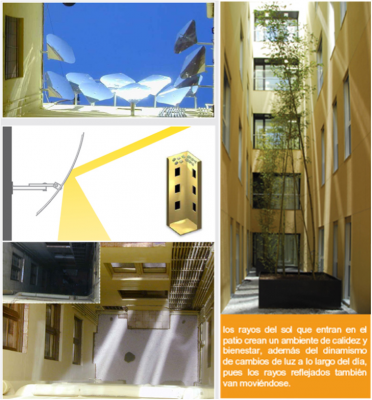
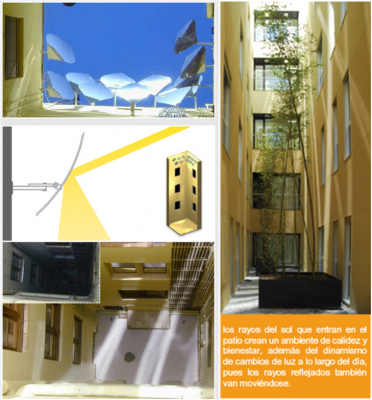
- 🪞 Heliostats and reflectors
Active devices that follow the sun’s path and reflect sunlight toward secondary mirrors, which then redirect it indoors.
Application according to space type
- 🏡 Interior rooms
Light conduction systems such as solar tubes or optical fiber are better suited for living rooms and enclosed spaces. - 🏛️ Galleries and inner courtyards
Heliostats and reflectors perform better in open spaces with sufficient height.
Installation difficulty and feasibility
In existing buildings, installation requires construction work, with difficulty depending on the length of the system. Many tubes can be routed between beams and partitions without affecting the structure. A two-meter duct can be installed in a few hours, while optical fiber systems are often easier to deploy.
Comparative table of natural lighting systems
| System | Type | Energy input | Recommended use |
|---|---|---|---|
| Solar tubes | Passive | None | Interior rooms |
| Optical fiber | Active | Low | Spaces requiring light control |
| Heliostats | Active | Medium | Courtyards and galleries |
Technical summary. To light dark interior spaces, natural light must be captured from exposed areas and conducted or reflected indoors. Solar tubes offer a simple passive solution, optical fiber allows greater control, and heliostats are effective for inner courtyards.
Source. Technical guide prepared by the Vilssa editorial team, specialized in architecture, interior design, and natural lighting solutions.
To explore more content about lighting interior spaces or read related articles such as lighting an interior courtyard using reflectors, you can use the Vilssa search engine.
According to the U.S. Department of Energy, well-designed daylighting systems reduce energy consumption and improve visual comfort in buildings.
Publicaciones relacionadas:
 Natural Light Capture Systems: Heliostats and Fiber-Optic Daylighting Explained
 How to Reuse Light Bulbs for Decoration Step by Step
 How Much Can You Save with a Natural Gas Boiler? | Aerothermal Heating Explained
 How to Apply Natural and Cross Ventilation to Reduce Overheating
 Quiero hacer yogur de la forma más natural posible.
 Decoración de baño serie Vita-lino natural