


Electricity energy cost differences between efficient and inefficient homes
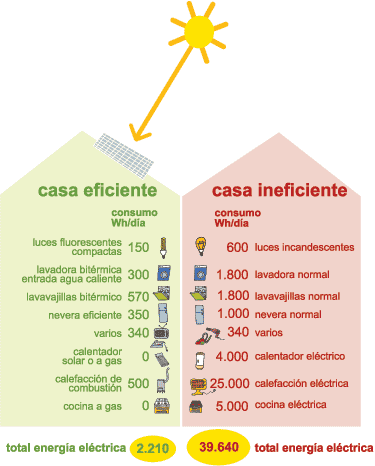
Differences in electricity energy costs between an efficient and an inefficient home
Understanding the differences in electricity energy costs between an efficient and an inefficient home
is a recurring topic when discussing energy efficiency in architecture.
This approach is not only based on environmental sustainability,
but also on a design philosophy where household economy plays a key role.
From a technical perspective, energy efficiency in buildings is a well-documented concept.
You can find general information about this topic on
Wikipedia.
🏡 In sustainable architecture, both bioclimatic and passive design strategies
and more efficient building systems are analysed.
All of this leads to a clear result: significant savings on electricity,
heating and domestic hot water bills.
For many households, reducing energy bills is the main reason for rethinking
the way their homes are designed or refurbished.
If this is your case, you may find this article useful:
I spend too much on heating.
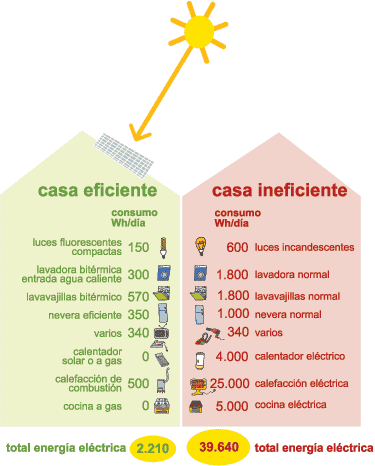
📊 Consumption differences between an efficient and an inefficient home
Based on a study carried out by the Barcelona Energy Agency,
two completely opposite housing models are compared:
an energy-efficient home and an inefficient home.
🔍 The greatest differences in energy consumption are found in:
- 🔥 Heating systems
- 🍳 Cooking appliances
- 🚿 Domestic hot water
- 💡 Lighting and household appliances
Although the consumption of small appliances may seem insignificant,
the overall savings can easily exceed €100 per month.
This makes energy efficiency a key factor when choosing appliances
and heating systems for the home.
🔥 Electric heating: the highest energy consumption in the home
Without a doubt, the largest share of energy consumption in a conventional home
comes from the heating system.
The issue is not only the system itself, but mainly the energy source.
⚡ The efficiency of an electric heater is not very different from that of a gas heater.
The same applies to boilers, whose efficiency is usually below 1,
regardless of whether they run on gas, oil or electricity.
💰 The real difference lies in the cost per kilowatt-hour.
Electricity-based kWh is significantly more expensive
than kWh generated from natural gas.
This is why electric heating often leads to much higher energy bills.
📉 By analysing the data and the comparative chart,
it becomes clear that carefully selecting the type of installation
and household appliances can result in considerable annual savings.
🔎 Related content on energy efficiency
If you would like to explore more articles related to energy savings at home,
you can use our internal search engine:
👉 Search articles about energy efficiency
Publicaciones relacionadas:
 How to Achieve an Energy-Efficient Home: Practical Low-Energy Strategies
 Is Electricity a Clean Energy? The Truth Behind Its Real Impact
 Guide to Buying a Wood Stove or Fireplace: Key Differences and Heating Efficiency
 Prefabricated Industrial Buildings: Fast and Efficient Modular Construction
 Casas Low cost
 Can We Live Without Oil? Future Energy Alternatives and Sustainable Substitutes